Can we map The Odyssey? How ancient geographers and modern researchers have traced Odysseus’s travels

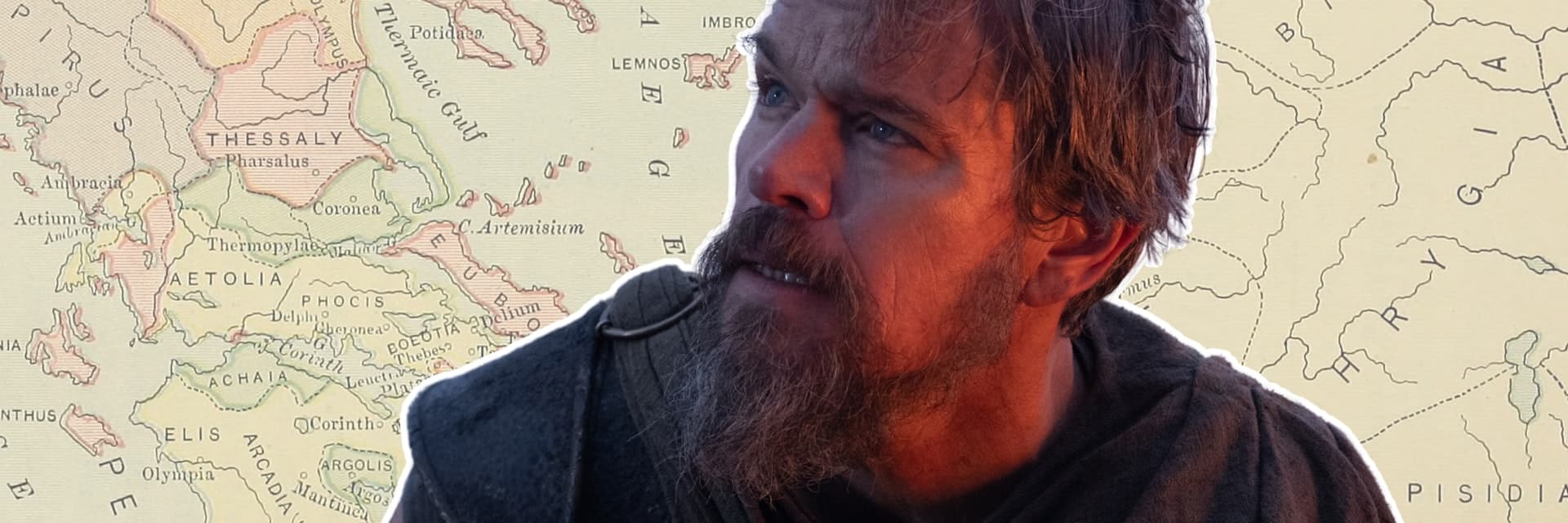
Homer’s Odyssey is a quest, following King Odysseus’s ten-year journey back home to Ithaca after the Trojan war. It is a tale with distinct geographic, spatial and temporal dimensions. It is no wonder that for centuries, people have been intrigued by the places mentioned in the Odyssey, wondering how many of them were real.
A few historians and classical scholars argue that the Odyssey is only poetry. As a work of art and pure mythology, they claim, there is no point looking for these places on a map.
The ancient Greek polymath Eratosthenes, who was the first person to measure the circumference of the Earth, disputed that the Odyssey had anything to do with geography. He said: “You will find the scene of the wanderings of Odysseus when you find the cobbler who sewed up the bag of the winds.”
I have researched the history of cartography and mental mapping for more than two decades. To me, the geographical elements of this story are what grounds it. Odysseus’s desire to find a way home lies at the very heart of the poem. And Odysseus changes as he moves across these various places and spaces.
Mapping the myth
The ancient Greek historian Polybius, who came 600 years after Homer, believed The Odyssey was a real story with some myths, rather than the reverse. He insisted that some of the fishing practices near Scylla, for example, were similar to those in the islands of Sicily, so Scylla must be located off the coast of Sicily.
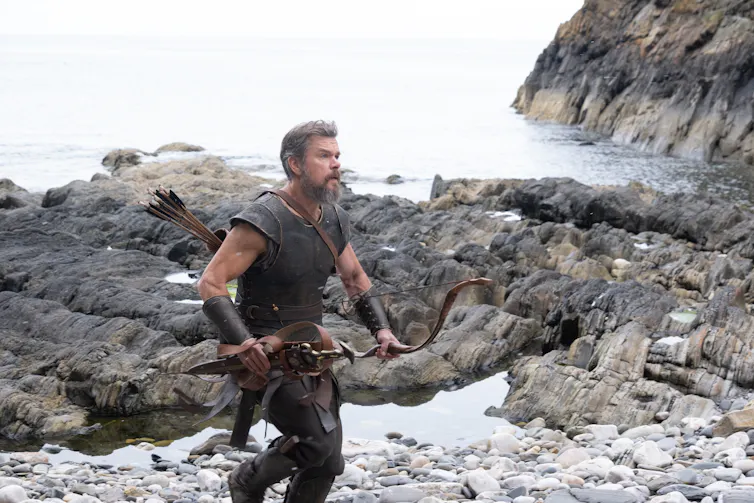
The Odyssey follows the journey home of Odysseus and his men after the Trojan war. Universal Studios
Strabo was a Greek philosopher and geographer writing almost seven centuries after Homer. His 17-volume Geographica is a comprehensive atlas and encyclopaedia of Greek life during Emperor Augustus. It also tells the story of islands of men and women in the Indian Ocean, just as Homer depicts in The Odyssey:
In the ocean, there is a small island, not very far out to sea, situated off the outlet of the Liger River; and the island is inhabited by women of the Samnitae, and they are possessed by Dionysus and make this god propitious by appeasing him.
Legends and myths from the time talk about women who seduced men and led them into danger. They were women such as Homer’s Circe, who he describes as “a dreadful goddess with lovely hair”. She lives alone on the island of Aeae with her docile wolves and lions, and lures Odysseus and his men to her to turn them into pigs.
Homer also writes of Calypso, who keeps Odysseus in “sexual captivity” on her island of Ogygia for seven years. Alternatively, this is where Odysseus remained voluntarily until he decided that he had had enough, depending on the translation.
In the maps and globes of the ancient world, myths and the real world overlap and intersect. The Roman mathematician and astronomer Ptolemy, who mapped the known world in 150BC, showed many of these Homeric places in his maps, such as the Lotophagitis (the land of the Lotus-eaters), Circaeum Promontorium (Aeaea, Circe’s kingdom) and Sirenusae Insulae (the island of the sirens).
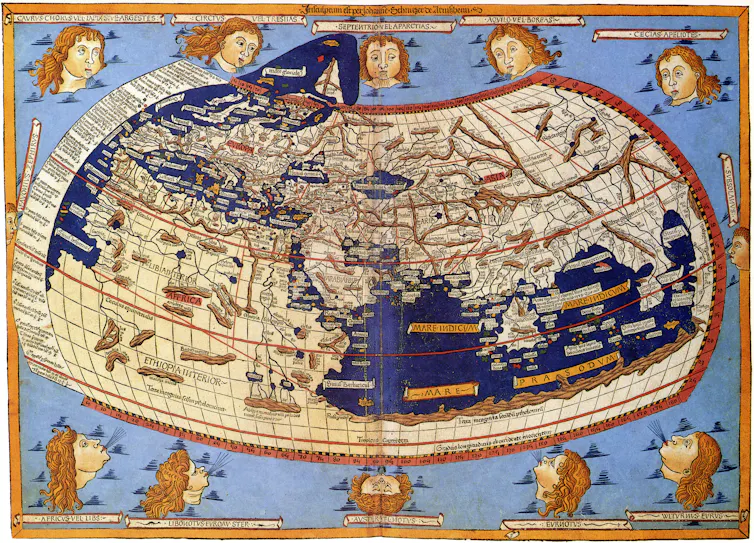
The Cosmographia Germanus, a 15th-century recreation of Ptolemy’s map of the known world. Cartanciennes
Attempts to transpose these locations accurately to modern maps have been difficult. Ptolemy’s calculations of latitudes and longitudes were based on a vastly different projection and understanding of the Earth’s circumference. An approximate matching of the locations to modern maps hints at Lotophagitis being located in Africa.
In the late-16th century, Dutch mapmaker Abraham Ortelius mapped Odysseus’s journey for the first time in its entirety in his Theatrum Orbis Terrarum. It was called the Map of the Wanderings of Ulysses, Ulysses being the Latin name for Odysseus.
Ortelius represents both the mythical and fictional worlds of Odysseus as scientific facts, and claims that Ithaca is modern Corfu. Homer had placed Calypso’s island off the coast of Scheria, a mythical haven and the final stop for Odysseus before returning to Ithaca.
There was no island west of Corfu, so Ortelius created a fictional island on his map. This became the basis for future maps, and so the imaginary island kept appearing through the 19th and 20th centuries.
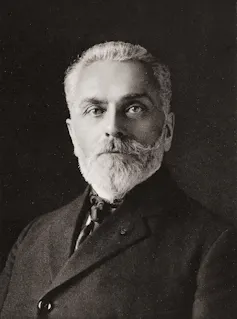
Victor Bérard in 1915. WikiCommons
In 1912, Victor Bérard, a French politician and traveller, tried to retrace Odysseus’s journey by travelling the same route. He placed Calypso’s island near Gibraltar, and the land of the Lotus-Eaters as Djerba off southern Tunisia. He placed the land of the Cyclopes at Posillipo in Naples.
Bérard’s theory was that Homer’s Odyssey was influenced by Phoenicians’ travels and maps – coastal sailing directions that used the stars as guides. But many of these maps lived in people’s imaginations and stories, rather than as real objects.
In search of Ithaca
One of the most significant debates in unravelling the geography of The Odyssey has been to pinpoint where Ithaca really was.
For a long time, scholars have argued that it must be the island of Ithaki in the Ionian sea. The problem is that Ithaki is mountainous, while Homer’s Ithaca is “low-lying”.
Researchers from Cambridge and Aberdeen have recently proposed that Ithaca was never described as an island in Homer’s description. Instead, they suggest he describes it as land or country that is part of a bigger island.
This would suggest that Paliki, lying on the western coast of Kefalonia, is a better candidate. Geo-scientific investigations and archaeological excavations have uncovered that Paliki was a significant bronze age site, and hence a plausible location.
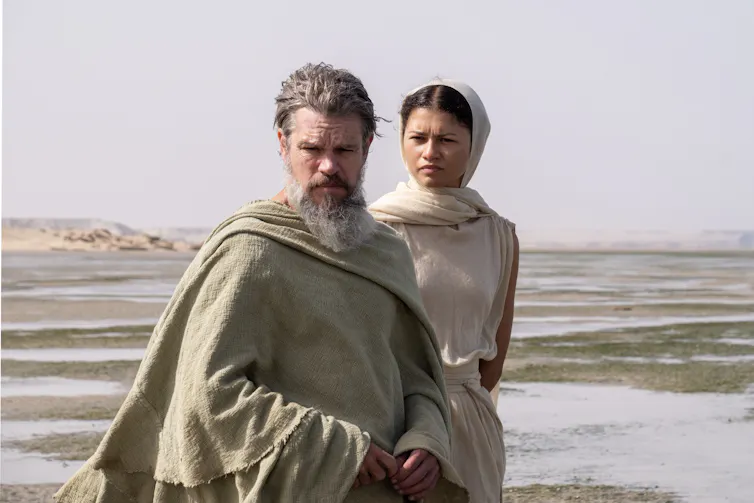
Matt Damon as Odysseus and Zendaya as Athena. Universal Studios
The locations from Odysseus’s journey might map on to real-world locations, or they might be purely myth. Either way, the inter-relationship of these locations tell us a story of a yearning for home and search for belonging. It also throws light on how the ancient writers saw our world as filled with mystery and dangers.
The geography of The Odyssey is a lens through which to understand the vulnerabilities and fears of men in the ancient Greek world. Maps of Odysseus’s journey might not be real, but then all maps lie.
Maps are only a story we tell ourselves – a journey into the unknown, far beyond the boundaries of our imagination. In The Odyssey, Homer was not only mapping the world, but building a world.
This article features references to books that have been included for editorial reasons, and may contain links to bookshop.org. If you click on one of the links and go on to buy something, The Conversation UK may earn a commission.
Author
Visiting Professor of Social Inequities and Injustice, Loughborough University
Disclosure statement
Pragya Agarwal does not work for, consult, own shares in or receive funding from any company or organisation that would benefit from this article, and has disclosed no relevant affiliations beyond their academic appointment.
Partners

Loughborough University provides funding as a member of The Conversation UK.
The Conversation UK receives funding from these organisations
DOI
https://doi.org/10.64628/AB.cemtw696f

We believe in the free flow of information
Republish our articles for free, online or in print, under Creative Commons licence.
Republish this article
Something Good
Your free time is precious, so spend it with something that an expert has guaranteed will be good. Our arts newsletter cuts through the noise with carefully curated recommendations of the best in film, TV, books, and UK exhibitions – straight to your inbox every Friday.
Subscribe for free

Anna Walker
Senior Arts + Culture Editor
You might also like
The Return: how each new retelling of The Odyssey opens up the worlds of the women in this epic
A goat’s tooth may have solved a 100‑year debate about ancient Greek farming
Odyssey by Stephen Fry – the tales of return from the Trojan war are charmingly retold but at an uncomfortable cost
The Bayeux tapestry and the hidden history of the women who embroidered it
0 Comments
There are no comments on this article yet.
Have your say, post a comment on this article.
Events
The Women's Library at 100: celebrating a century of collections — London, City of
UCL Centre for Engineering Education Summer Short Courses — London, City of
Advances in Geospatial Data Science — Southampton, Hampshire
Privacy policyTerms and conditionsCorrections and complaints
Copyright © 2010–2026, The Conversation Trust (UK) Limited
Like what you’ve read? Want more like this? Try our Daily Newsletter
Subscribe for free
This site is protected by reCAPTCHA and the Google Privacy Policy and Terms of Service apply.